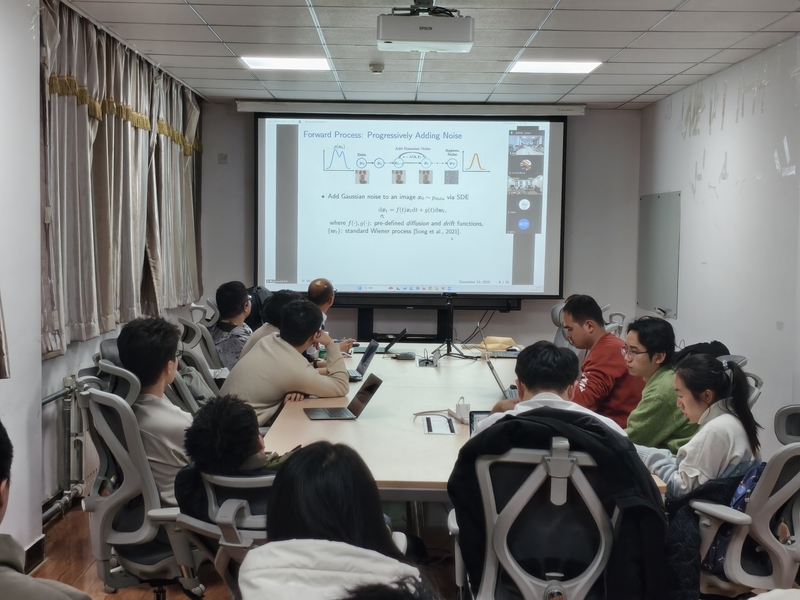
澳门大学汪鹏博士应邀做专题报告
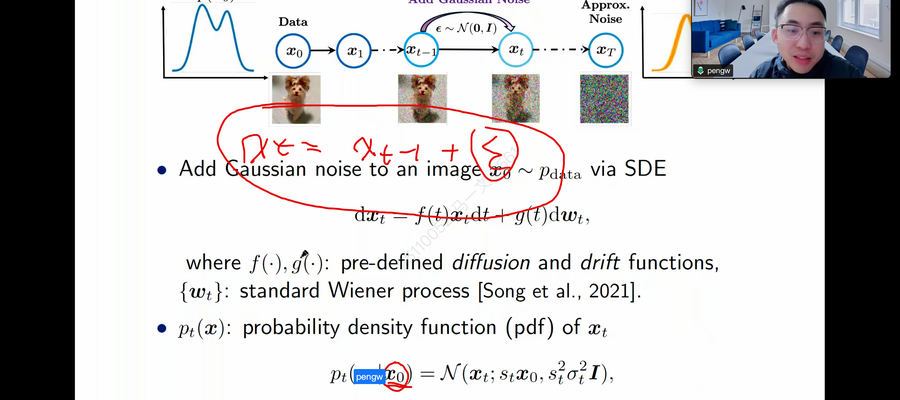
2025年12月12日MIC实验室非常荣幸地邀请到澳门大学汪鹏博士为实验室全体师生做线上专题报告。汪鹏博士致力于深度学习优化、机器学习与人工智能的交叉领域研究,报告中分享了近期研究进展与未来可能的方向。
现场互动环节气氛热烈,师生就相关议题展开深入交流。此次报告旨在促进学术交流、拓展师生视野。报告结束后,与会师生均表示受益匪浅,对汪鹏博士的精彩分享给予高度评价。
本次专题报告内容简介如下:
题目:Understanding Distribution Learning of Diffusion Models via Subspace Clustering
摘要:Recent empirical studies have demonstrated that diffusion models can effectively learn the image distribution and generate new samples. Remarkably, these models can achieve this even with a small number of training samples despite a large image dimension, circumventing the curse of dimensionality. In this work, we provide theoretical insights into this phenomenon by leveraging key empirical observations: (i) the low intrinsic dimensionality of image data, (ii) a union of manifold structure of image data, and (iii) the low-rank property of the denoising autoencoder in trained diffusion models. These observations motivate us to assume the underlying data distribution of image data as a mixture of low-rank Gaussians and to parameterize the denoising autoencoder as a low-rank model according to the score function of the assumed distribution. With these setups, we rigorously show that optimizing the training loss of diffusion models is equivalent to solving the canonical subspace clustering problem over the training samples. Based on this equivalence, we further show that the minimal number of samples required to learn the underlying distribution scales linearly with the intrinsic dimensions under the above data and model assumptions. This insight sheds light on why diffusion models can break the curse of dimensionality and exhibit the phase transition in learning distributions. Moreover, we empirically establish a correspondence between the subspaces and the semantic representations of image data, facilitating image editing. We validate these results with corroborated experimental results on both simulated distributions and image datasets.
讲者个人简介:汪鹏博士是澳门大学计算机与信息科学系的助理教授。在此之前,曾在密歇根大学担任博士后研究员,合作导师为Laura Balzano和Qing Qu教授。他于香港中文大学系统工程与工程管理系获得博士学位,导师为Anthony Man-Cho So。他的研究兴趣主要位于优化、机器学习与人工智能的交叉领域。当前,他的研究重点在于探索深度学习的优化基础,包括监督学习模型、扩散模型以及大型语言模型。